The 1D chair armrest is the most widely used armrest system in office seating — and consistently underestimated. A single axis of vertical adjustment, done correctly, eliminates the shoulder elevation and forearm strain responsible for most desk-related upper-body complaints.
65% of office workers report neck or shoulder pain linked to improper armrest height
5–10 yr typical service life of quality 1D armrest mechanisms under daily use
90° elbow angle target — achieved through height adjustment alone in most users
1D Chair Armrest Height Adjustment: The One Setting That Changes Everything
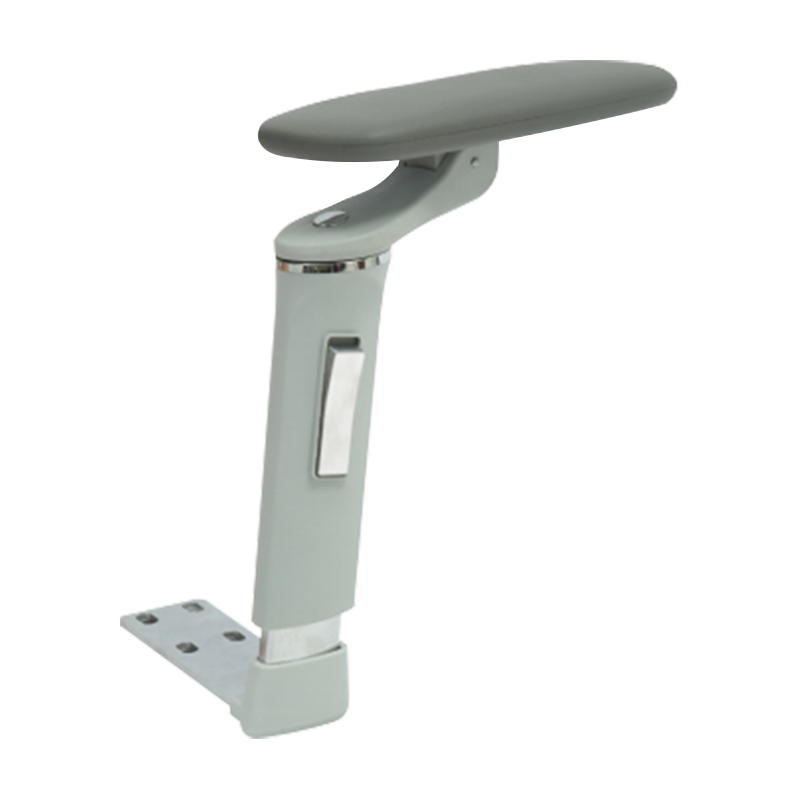
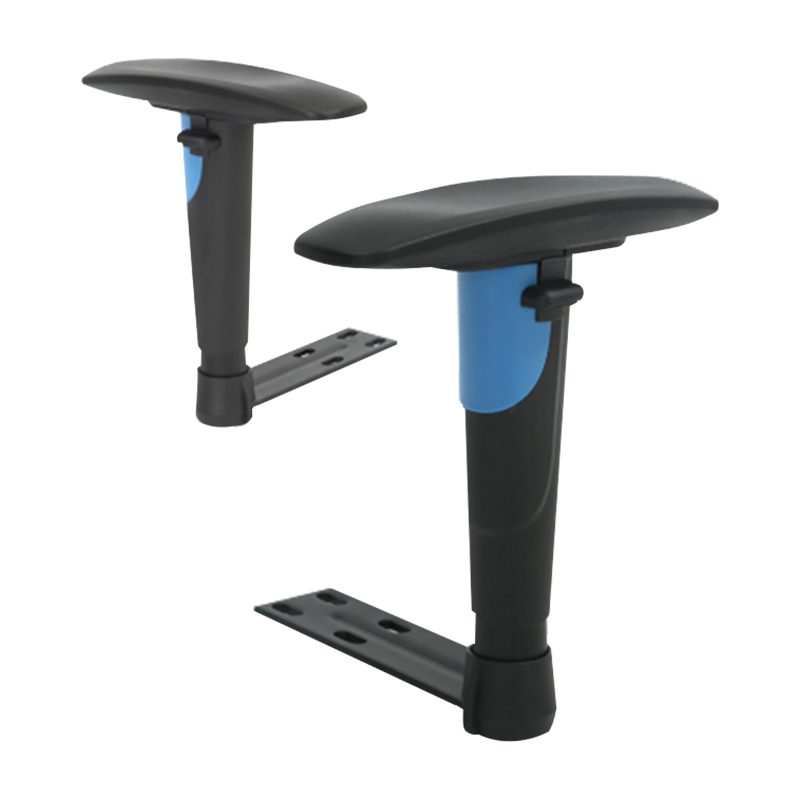
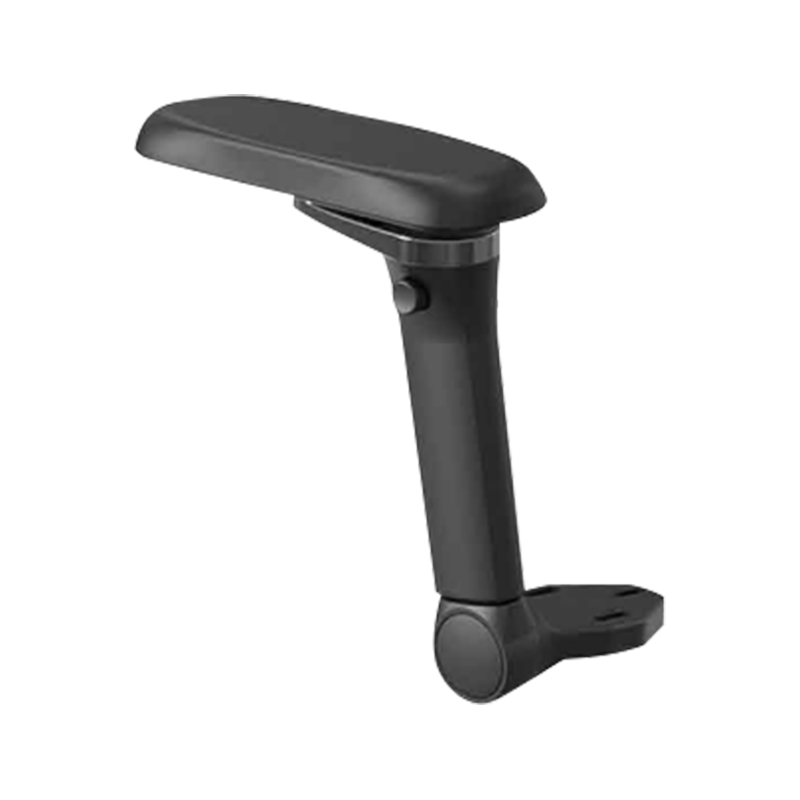
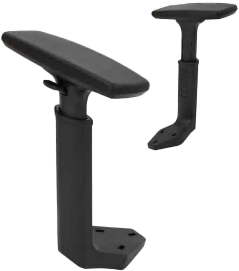
1D chair armrest height adjustment operates on a single vertical axis — the armrest pad moves up or down, locking into indexed positions via a push-button or lever mechanism built into the armrest post. No rotation, no lateral shift, no pivot. That simplicity is its defining strength: one adjustment, done once, correctly, eliminates the postural compensation that develops when arms hang unsupported or rest too high.
The correct height places the elbow at 90–100 degrees with the shoulder relaxed downward — not elevated. When set correctly, the forearm rests on the pad without the user hunching the shoulder upward to reach it or dropping the elbow off the edge entirely. Research published in Applied Ergonomics found that proper armrest height reduces trapezius muscle activation by up to 45% compared to unsupported postures — a measurable reduction in the primary muscle group responsible for tension headaches and cervical strain.
A 1D chair armrest is defined by a single degree of freedom: vertical height adjustment only. The pad, post, and bracket move as a fixed unit on one axis, with no independent pivot, rotation, or lateral translation of any component.
1D Chair Armrest Ergonomic Support: What One Axis Actually Covers
1D chair armrest ergonomic support is sufficient for the majority of seated work tasks when the workstation is correctly configured. The premise is this: if the desk height, monitor position, and chair height are set to match the user's body, height-adjustable armrests supply the remaining variable — forearm elevation — without requiring additional axes of movement.
Shoulder decompression
Resting the forearm at elbow height transfers the weight of the arm — roughly 5% of body weight — from the shoulder girdle to the armrest. Over an 8-hour shift, this prevents cumulative fatigue in the rotator cuff and upper trapezius.
Wrist neutrality
When the forearm is supported at the correct height, the wrist naturally hovers at or near keyboard level without flexion or extension. This reduces carpal tunnel pressure by up to 30% compared to unsupported forearm positions, per Cornell University ergonomics data.
Lumbar load reduction
Armrest contact reduces the effective load on the lumbar spine during seated work. A 2019 study in the International Journal of Industrial Ergonomics recorded a 17% reduction in spinal compressive force when armrests were used versus absent.
Seated transitions
1D armrests at correct height provide a consistent push-off surface when rising from the chair — a functional benefit often overlooked in ergonomic assessments but clinically significant for users with lower-limb weakness or hip replacement history.
1D Chair Armrest Durability: Why Fewer Moving Parts Last Longer
1D chair armrest durability is structurally superior to multi-axis systems for one straightforward reason: fewer moving components means fewer failure points. A 3D or 4D armrest contains lateral sliders, pivot joints, and rotation bearings — each with its own tolerance stack and wear surface. A 1D armrest mechanism consists of a post, a locking collar or indexed button, and a pad mount. Three components. Three wear points.
| Component |
1D Armrest |
3D/4D Armrest |
| Moving parts per arm |
1 axis mechanism |
3–4 axis mechanisms |
| Typical service life |
5–10 years |
3–6 years |
| Most common failure |
Button spring fatigue |
Lateral slider wear / pivot loosening |
| Replacement difficulty |
Low — standard post diameter |
High — proprietary multi-part assembly |
| Pad replacement |
Universal fit common |
Often model-specific |
Post material is the primary durability differentiator within 1D designs. Glass-filled nylon posts outlast standard ABS by a factor of two to three under lateral load. Steel-core posts with nylon overmold represent the highest-durability tier and are standard in contract-grade seating specified for 24-hour use environments such as call centers and dispatch facilities.
1D Chair Armrest Replacement: When and How to Swap Correctly
1D chair armrest replacement is the most straightforward armrest service task in office seating. The standard post diameter across most chairs is 19mm or 22mm — two dimensions that cover roughly 80% of the market. Measuring the existing post before ordering a replacement eliminates compatibility errors that account for the majority of returned armrest units.
01
Remove the existing armrest
Tilt the chair seat forward to access the underside. Most 1D armrests secure via two to four bolts through the seat pan bracket — M6 or M8 in standard chairs. Remove bolts fully and lift the armrest post from the bracket socket.
02
Measure post diameter and bolt pattern
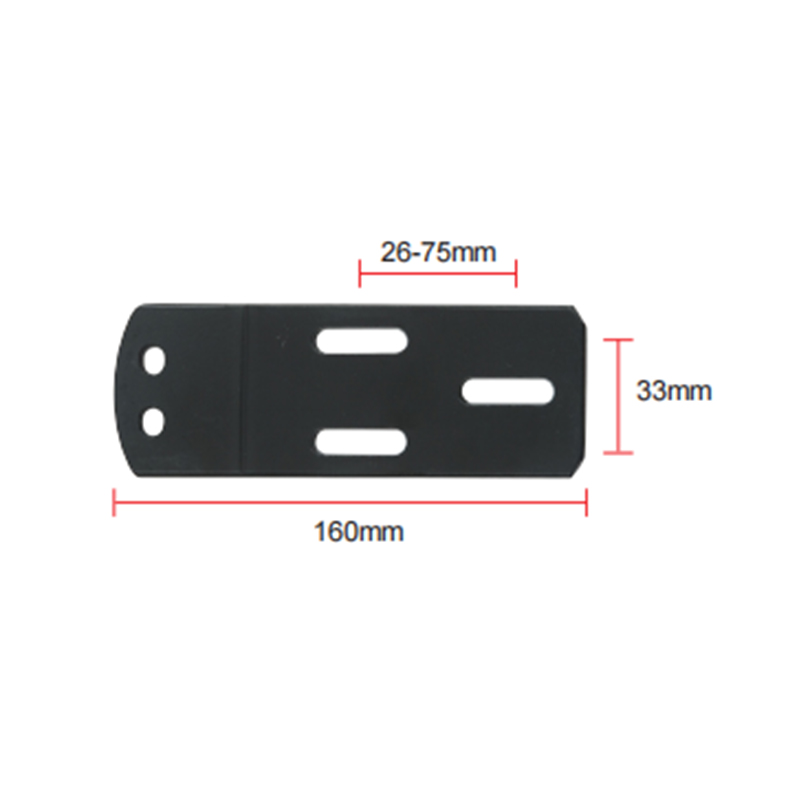
Use calipers to measure the post outer diameter at the base — either 19mm or 22mm in most cases. Photograph or measure the bolt hole pattern on the seat bracket: center-to-center spacing in mm. Both dimensions are required for an exact replacement match.
03
Select replacement by load rating
Contract-grade 1D armrests are rated to 120–150kg dynamic load. Consumer-grade units are typically rated to 80kg. Matching or exceeding the original load rating preserves the structural integrity of the seat bracket over time.
04
Install and torque correctly
Insert the post into the bracket socket and thread bolts finger-tight before final torque. Over-torquing nylon seat brackets is the primary cause of bracket cracking during DIY installation — use 4–5 Nm for M6 bolts, 8–10 Nm for M8.
1D Chair Armrest for Office Chairs: Matching the Right Chair Type
1D chair armrest for office chairs performs best when paired with task chairs and mid-back executive chairs used in standard desk environments. The fixed horizontal position of a 1D pad is compatible with straight-on keyboard use — the dominant posture in data entry, writing, and general computer work. For chairs used in collaborative or informal seating where users frequently rotate to face other people, a wider pad or angled fixed pad adds value without requiring a multi-axis mechanism.
1D Chair Armrest vs 3D Armrest: An Honest Comparison
The 1D chair armrest vs 3D armrest decision reduces to two questions: how varied is the user's seated posture, and what is the budget and durability priority? For users who sit primarily in front of a monitor performing keyboard and mouse tasks, a 1D armrest at the correct height outperforms a 3D unit in long-term consistency — multi-axis mechanisms drift from their set positions under daily use, requiring periodic readjustment that users often skip.
Choose 1D When
- Primary task is keyboard and mouse work
- Workstation depth and chair height are fixed
- Long service life and low maintenance matter
- Replacement parts availability is a priority
- Budget is moderate — 1D units cost 40–60% less than comparable 4D models
Choose 3D/4D When
- User frequently rotates between multiple work surfaces
- Chair serves multiple users with significantly different builds
- Tasks include drafting, design, or wide lateral arm movement
- User has documented asymmetric shoulder or arm conditions
- Premium contract specification requires maximum adjustability
For the majority of office environments, a correctly set 1D chair armrest delivers full ergonomic benefit at a fraction of the complexity and cost of multi-axis alternatives. The best armrest is not the one with the most axes — it is the one that stays in the right position every day without readjustment.



 English
  Español
  عربى
عربى 


 Feel free to contact us